
Umwelt Poems
“Should we not learn the lesson that, for example, the woods, which poets praise as the human being’s loveliest abode, is hardly grasped in its true meaning if we relate it only to ourselves?” — Jakob von Uexküll,
The biosemiotic project of articulating structures of sympathy between humans and non-humans is, in some sense, doomed without poetic intervention. Ecological studies that follow competitionist or explicitly evolutionary facts attract the offense of biosemioticians — yet biosemiotics (as with any project of thought) remains divorced from its subject matter so long as it fails to animate its practitioners with the whole of their being. The animative transport, this ekstasis of biosemiotics, is, of course, the very purpose and origin of poetry. In these five poems, I attempt to give a poetic animation to five imaginatively-rendered Umwelten of organisms involved with one central organism, an Oak Tree
Poetry by Thorolf van Walsum.
The Human
Through the brush-brashing, I on a humid meadow found,
Laid like a medusa, the cast shade of a great oak.
Hacked and re-leaved, mangled, still from ground
He poured e’er upwards, as though thunderbolt-provoked.
The little things, the insect wings, gave reverential hum
To the cherishing monarch of this beaten wood.
Save my summering sweats, I gave only dirty awe,
Which I laid with a kiss planted where he stood.
No sooner I’d done so than alive my steaming mind thrummed
As though snake-bitten by beauty the pained fairies sung
A thousand-chested harmony to human world unthaw.
The flowers each persepine-touched, whose dangling roots
Run down to nurture the churning children amid the dark,
So variably gnashing or returning among the loamy soots
Should named spirits be of the moon, grass, or ark.
From shadow’d acorn-hall, I saw peek the flitting faces
Of messenge-cheeked tricksters, and dumb-tailed rats.
Among the ancestors and black eaters of a delectable sun
Danced a thousand nymphid shades on one squirrel sat.
Upon two beads, a twitching nose, a thousand stories lace
The fairies strung have stolen boys who wondr’ing lost their place,
But, not I, not I, who will from turbid spirits run.
How twitch and wave the beetle’s nose when scuttling up the skin
Of an older beast of green and peace, who speaks in scented sighs.
What smells he. How move they! Why drop the shell and buzz the wind
This little soul a-carapaced can speak beneath our eye.
Let ever-lengthened maps discover newer and newer lands,
Let fumbling astronauts in space tickle starry dusts.
The burning, broiling, flames a-foot when leaven we from earth
Conceal the charred bones of man, who turn from rust to rust.
Never will enough be said, by myth or dissecting hand,
Of squirrels, ants, and foxes, bats, nor the ever-added ‘and’.
Why sour we so easily on nature’s listless births
When as angels metal-winged we fall from worldly mirth?
An Owl

When I come to this place, it is for the making of wishes.
Many distances ruffle and approach and breathe languidly
Across my feathers. A blink falls. Beneath the brilliant moon
A thousand leaves, particle-blades, turn and flip in gentle noise.
Perhaps I shall eat. Thrice have I left, plucked, carried,
Ripped to pieces tonight. And yet, and yet,
The world glistens ever onwards. I wish for no further mice
Squirrel
The Tail of Terpen Tappenspre
Springs Higgle-Piggle Tree to Tree
A Busy Body, Nut-Natured, Rich
I Shake Down The Fruits
then Clutch-Carry from Ditch.
Here, Here, or There Rooted
Dig Scramble Seeds Set
The Trove-Moles of Acorns
Where, Where, I Forget.

Oak Tree

mmmmmmmmmm
mmMMMMMmMM
MMMMmMhhhhh
hhhshhhshhsh
hssshhphshs
Psshhshhsh
hhmmshhmmhm
mmmmmmmmm
The Ants
The Ants The darkness warm and fellow-filled
by sisters dug the Good was built
Though water found and younglings kept,
in hunger, food the Good now wills.
Go, we said, and to light swept
for aught to use our jaws adept,
but when from gate of Goodness went
no heady trails to senses leapt;
the faded trace of troves o’er spent
left sisters skit’ring, lines a-bent.
My sisters will on juices chew
when suckling fresh reports my scent.
The Goodness strong by limbs anew
I grow the Good, and world run through.
Over, and Under, and crossing the sand,
seeking a monster the golden-thread grew.
Ran onwards, space thickened, here the land
roughened and crusted, the light now a slant.
Yet here, my feelers in the air
take on hope, for jasmine signals grant
a trembling, promised, someone there.
Beyond, Beyond, my sisters will share
the Feast of a Beast reported o’er yon
whose jelly-fat hide I’ll rip, I’ll tear.
Through heavy plane pulled up and on
my shell a-lusting body drawn
of love for goodness, love for kin,
I’ll fill our dark as sky by dawn.
My greener guide, before and in
brought narrower roads where length was thin.
Around me, light in emerald shades
Danced triumphant thanks by wind.
I saw my object, fattened made
this Pulsing Wretch by his sucking-blades.
A body crawled by creeping slights,
spoke to Good’s hunger, and action bade.
I speeded forward, towards this might
and planted hard my venom-bite
The jerking, tractioned being wrung,
curling, twisted, and flexed to fight.
Clenching hard where I had stung
through batt’ring tosses I fervent clung.
Though strong my legs and strong my grip
No further hope now through me sung;
this curing behemoth’s skin so thick
my feet and fires start to slip.
My little jaws brought but a blister
upon this massive sagging lip.
Before I’m flung off by this twister
into the jaded world a-glister
Oh, let the Good be fed.
My god. My God! Upon the trail a sister!
Sprinting by my golden thread,
her lancing teeth and antlers red,
Her bite, Our bite, the maw of truth
will fuck this caterpillar dead.

Commentary

Any artistic project does well to balance the accessibility of the viewer with the ambivalence of its content. At face value, this makes the human-nonhuman relationship an ideal formula for art, as ants, squirrels, owls and trees are both open for a watcher’s observation and entirely mysterious to the human observer. The imaginative project of putting ourselves into the world of a squirrel can take many forms. Why I’ve chosen the forms that I have, however, may not be intuitively obvious to my readers, who, in all probability, have a different experience with and mode of approaching poetry than my own. By way of this assumed imperfect semiotic overlap, I think a little explication on choice of form, at least, is justified.
The Human
The Human poem is a three-part ode, following, with one slight deviation, the formula of John Keats’ odes. The rhyme scheme, ABABCDEDCCE, might symbolize, in the experience of the reader, the progression of a thought from simple consequentialist thought (the predictability of ABAB) to the roaring tumult of a romantic revalation (DCCE). If this is the case, it is bound to be better argued elsewhere. I chose Keats’ specific style because, in addition to my personal love for his poetry, I believe the semiotic mode of romantic bewilderment (what Keats called Negative Capability) to be the most significant aspect of what it means to be human; in a sense, it is being nothing at all. Formally, therefore, the choice is emblematic of a philosophy I attribute to humanity in general, although the themes elaborated are inspired by a particular scene in my memory.
An Owl
A significant portion of the Biosemiotic project is the deconstruction and reconsideration of red-in-tooth-and-claw and competitivist paradigms in biology. It aught to fascinate us, then, that the owl, the symbol of serenity and wisdom in Western civilization for as long as symbolism has existed, spends so much of its time at rest. Perch-based hunting is an almost meditative exercise when compared to the paces occupied by busier species. As such, I chose to render the owl in a variable free verse, that tenses and relaxes with the flow of our owl’s thoughts.
Squirrel
The squirrel poem was written in Sprung Rhythm, a metrical style invented by a favourite poet of mine, Gerard Manley Hopkins. Hopkins’ poetry, itself often concerned with the tensile liveliness of non-human organisms, animates poetry with a trouncing of irregular stresses, creating the effect of freneticism, energy, and passion. The playfulness, wit, and wholly unselfconscious agility of squirrels become the style wonderfully.
Oak Tree
This poem, if we dare to call it that, abandons almost all metrical conventions that have been accepted as formally pleasant for the human receiver. Dithrambs and iambs, modelled on the paces and rhythms of our human body, know no analogue as such in the vegetative world. To recreate the experience of an oak, I sought not rhythm or style, but in the affective sentiment that is associated with particular phonemes. A prolonged ‘mm’ sound, for instance, is one of warmth and seclusion; the ‘hh’ and ‘ss’ sounds, on the other, that of effusion and spatiality. Most broadly, this poem is an imaginative rendering of the diurnal photosynthetic cycle, which is most closely involved with the organism’s hydration, nutrition, and defence.
The Ants
Finally, The Ants, the last poem on the page, the first written, and probably my most inspired. The form used is a terza rima, associated with Italian epics, namely Dante’s Inferno. The interlocking chains of rhyme hold significance in that the plot of the poem follows an ant creating a pheromonal trail into the wild (suffuse with references to the Theseus-minotaur myth), but also due to its simple difficulty in English. Being a more phonetically brutal language, English rhyme schemes are much less given to floral delicacies such as terza rima, leaving very few English poets to pick up the style. Those that do, however, maintain the katabastic implication, such as Robert Frost’s ‘Acquainted with the Night’. The terza style, therefore, has symbolic weight as both the medium for adventure (the substance of the narrative) and for pushing the limits of English language (the alteriority of writing as an ant).
Photos used for An Owl, Squirrel, Ant, and Comentary are credited to Thorolf van Walsum.
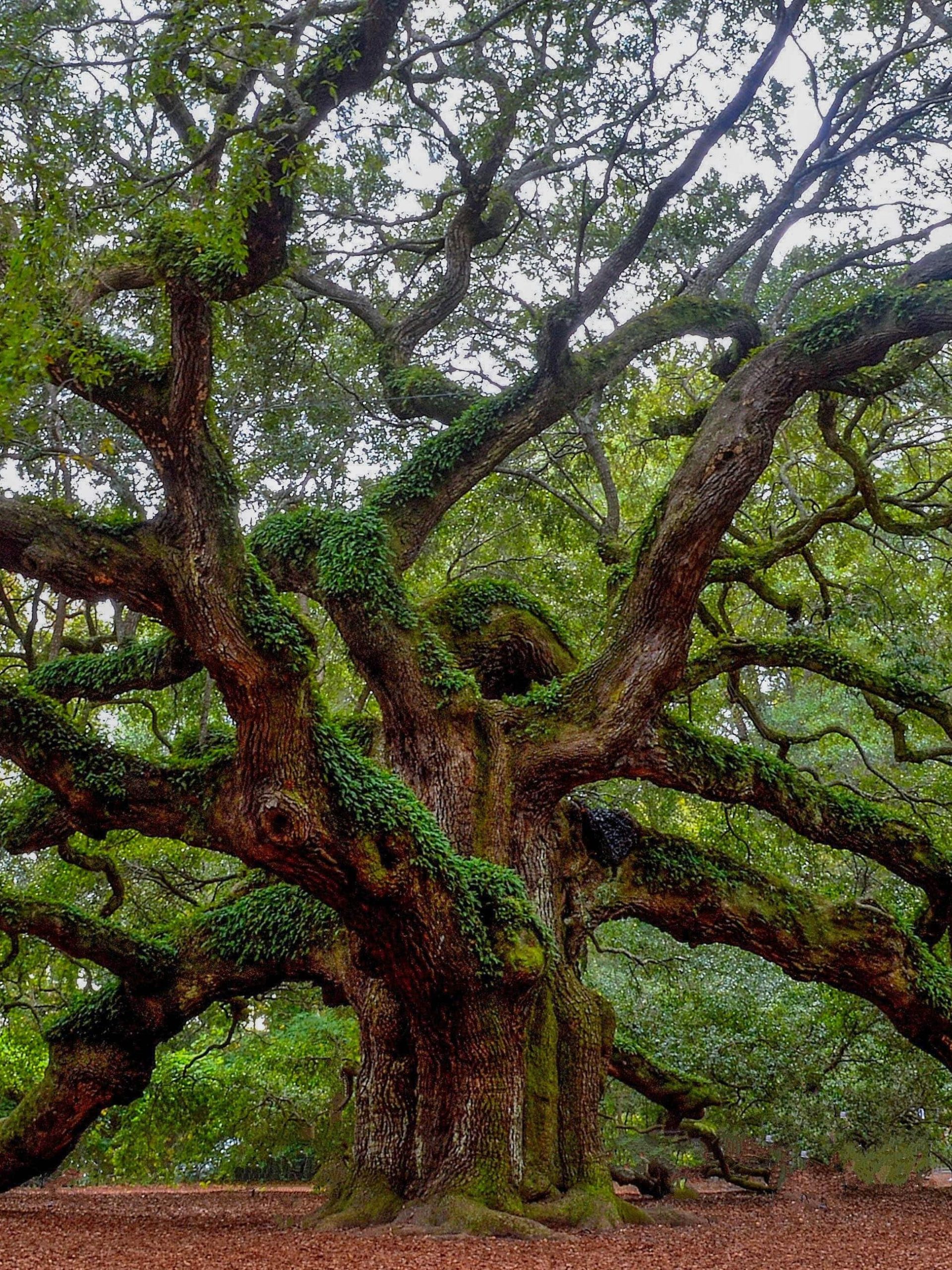
The photo used for The Human is titled, Angel Oak Tree, and is credited to Andrew Shelley.
The photo used for the poem, Oak Tree is credited to IGPOTY.