“How do we know? The effect of technology on knowledge and communication
Lemmit Kaplinski | January 26, 2021
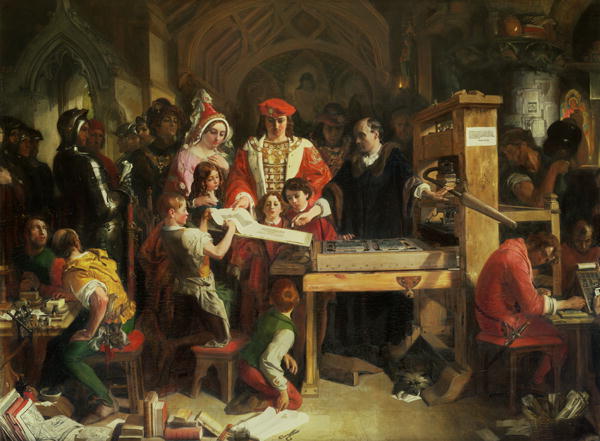
The invention of the printing press in the 15th century caused thorough changes within society. The simple act of multiplying texts on an industrial scale also brought about a profound shift in what we perceive as knowledge and how we “know things”. While this is accepted as true by most scholars, Elizabeth Eisenstein’s seminal work The Printing press as an Agent of Change (1969) was the first truly in-depth look at the mechanics of the transition. Based on her work I offer one possible way to describe the historic progression of the concept of knowledge. I also make ad-hoc comparisons to modes of signification and finally suggest insights into the post-truth communications scene of today.
“Word is God”: the communication of proper names
Communication can be categorized into ages among which oral, written, print and electronic are widely recognized. Each of these has been described in terms of how information is stored and disseminated, but less has been made of what is knowledge and how it is created (if at all). In an oral culture, one can say that the source of knowledge is tradition and knowledge cannot be easily created. Even though knowledge is embedded in the practitioner – be they storytellers, shamans or singers – these persons themselves have very little control over the material, and the audience “knows things” by participating in an eternal ritualized re-enactment. This is a collective act with very little room for individual opinion, as such oral knowledge seeks to maintain the status quo by resisting new knowledge. We can think of this as communication acts utilizing proper names, where the signified is itself the signifier and vice versa. This understanding was codified, namely, in Christian religion in John 1:1 “In the beginning was the Word, and the Word was with God, and the Word was God.”
Written culture as exemplified by monastic scribes of medieval European culture offers a marked change. The unity of the sign is broken, it is separated into dyadic or triadic components, described for example by Augustine. Knowledge ceases to be communal as by means of writing on scrolls or codexes, it can be and indeed to a large extent is separated from the original source both in space as well as time. Often the original author is long dead and knowledge becomes a myth of the Golden Age, most likely equated with the antiquity. It is something that once was, but despite the efforts of dedicated scribes, is becoming corrupt and dispersed. Thus knowing is the act of seeking out knowledge, sometimes by literally traveling to distant monasteries to access books not found elsewhere. It is a quest without an end, much like the quest to seek out the Holy Grail; Eco’s The Name of the Rose offers a thrilling and enjoyable summary of such an understanding of knowledge.
Funnily enough, we see the same theme of a Golden Age being played out centuries later when romantic scholars such as Grimm brothers or locally Hurt, Kreutzwald and other literates meshed print and oral traditions in folklore studies. The myth of the Golden Age spurred the writing and dissemination of national epics throughout Europe be they often works of contemporary fiction rather than carefully reconstructed originals.
The Printing House as a Bazaar of Ideas
Written culture has been widely described, but it has also been often equated with print culture. Eisenstein was one of the first scholars to point out how fundamentally different the communication models supported by scribal vs. print culture are. Starting just from the print shop itself that was born in the late 15th century as a private enterprise — in contrast institutions such as monasteries and universities had much less worry for the charts of supply and demand. Printing houses were meeting points between authors, theologians and secular scholars as publishers were always keen to find new material to print and sell.
In terms of the concept of knowledge, the proliferation of bibles is an apt example of the fundamental change in how the idea of knowledge was altered. The tens and tens of variations of bibles published at the dawn of the printing industry (The Bible is, after all, a guaranteed best-seller) made one thing painfully clear to scholars — the idea of one true bible having been created, preserved and passed on through the centuries was simply and plainly wrong. As the price of books plummeted (production costs of books could go down as much as 1000-fold by the end the 15th century), learned men did not have to travel far to be able to consult single copies of ancient manuscripts. Instead they could in their universities, monasteries, or even private libraries read and compare tens of different works on the same subject.
And the comparisons they could make bought to light the endless trail of misunderstandings, mistranslations, misquotations and other ways in which texts had been altered. Some of them turned out to be even horribly misdated as in notable cases, Carolingian texts were mistaken for ancient Roman manuscripts. As these truths became evident, the Catholic Church entrenched, declared a single version of the bible as the one and true, thereby stagnating research and development in its ranks for centuries. The rest of Europe accepted the fact that knowledge is an erroneous process that requires comparison and deliberation. More so, it requires adjusting long-held beliefs when new information is presented. Mapmaking went through a golden age when people across Europe correspondents could access same publications and send in their corrections. In a century, the face of the Earth changed from “here be dragons” to what was actual knowledge of navigators and merchants traveling on land and sea.
This form on knowing – of comparing, of corresponding with one’s peers and of rectifying beliefs based on evidence is the basis of scientific thought. This would not have been possible without the wide circulation of books, they in turn having been made abundant and relatively cheap by means of the printing press. Where the total number of books from the 15th century can be estimated in the millions, then 16th upgraded that number to hundreds of millions. As knowledge became networked, so did the the sign. While structuralism and semiotics are mostly disciplines of the the 20th century, the concept of sign systems dates back to the period. The age of the singular signs was over and today we consider meaning to only manifest itself in relation to other signs.
The medium is the message, or is it?
“The medium is the message,” McLuhan said next. Where the printing press lowered barriers to the spread of ideas, the internet made them all but disappear. This brought about another change in what is knowledge, and endless flamewars on Twitter now compete for what is truth and what is alternative facts or fake news. It is not possible to say what will be the outcome of this development no more than it was possible to say that Gutenberg’s bible would lead to Martin Luther’s bible and that Europe would never be same again. We can however make predictions based on observing previous trends.
The careful dance between private enterprise and political power will continue to try and balance itself by establishing control in the form of copyrights and censorship as had happened already in the 16th century and onward.
What will constitute knowledge for future generations will more likely have less to do with individual facts and more to do with the choice in sources of information. There is more information on the web than any scholar, research group, or think tank could ever hope to wade through, thus the key to knowing is limiting the amount of information processed. “Knowing” is to have the skills and habit of filtering out non relevant information, not by careful comparison of print culture, but by sheer omission. This process will be helped by various tools powered by heuristics as well as artificial intelligence, caringly referred to as “the algorithms”.
Another little discussed possibility is for knowledge to become a higher-order emergent property of electronic communication systems and thus become unfathomable to humans. This is to an extent supported by the concept of memetics as discussed by Blackmore and Dawkins.
How will AI play this game in the long run is yet to be determined. It will doubtlessly also act as an original creator of content for the ever-expanding cloud. There is cause to consider this as the makings of a fifth communications revolution, but with the technology still evolving, it is too early to declare so.
Regardless of the role of AI or the evolutionary processes of memetics, it is clear to the author, that all mayor shifts in our understanding of knowledge have taken place at an ever-increasing pace and resting on specific technological advances. While none of them in and of themselves can be considered a singular event, the connection between technology and culture is undoubtedly much stronger than we’ve so far acknowledged it to be.