
Semiotic Analysis of “The Elephant Man”
Andrei Bleahu | February 2, 2021
Introduction: visual “myth” creation
The Elephant Man is a historical drama, directed by David Lynch. It is centred on the life of John Merrick. Merrick, a man with severe deformities, was born in Victorian England, a time of heavy industrialization where freak shows masked the presence of a class-ridden society.
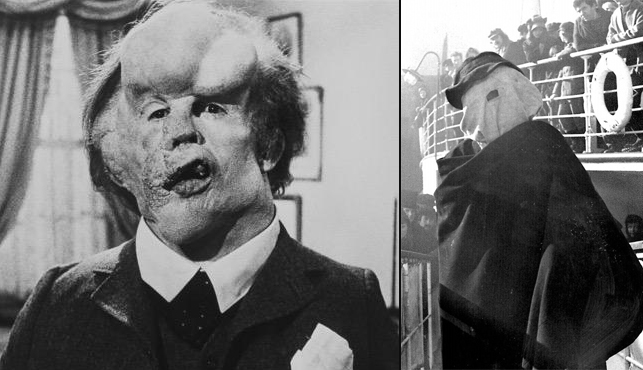
The film presents the story of John Merrick’s transition from his life as a circus curiosity, where he is exploited by a greedy and violent ringmaster known as Mr. Bytes, to life at the London Hospital under the care of Dr. Frederick Treves. Although he is initially seen as intellectually impaired and classified as an “incurable”, Merrick recovers from the abusive treatment of Bytes while under the care of Dr. Treves and the nurses at the hospital, eventually showing intelligence and sensitivity above average. The story depicts Merrick’s journey from his initial position as a “circus freak”, to becoming a different kind of curiosity in high London society. However, his life at the hospital is considerably improved. Although he is “captured” by Bytes and forced to perform in the circus again, he manages to escape with the help of the other “circus attractions” and return to the Hospital where he would spend the remainder of his days.
I chose the introductory scene of “The Elephant Man” to show how semiotics can be applied to reveal its underlying codes. Making sense of an object, such as this scene, comes at a price. There are many ‘worlds’ of interpretation which lie beyond the one created by the choice of concepts. With every choice made, the object reveals something that would otherwise be registered unconsciously. Inevitably, this analysis will crystalize the meaning of this montage by showcasing it in a particular light, by looking through a pair of ‘distortion spectacles’; some hidden worlds will be revealed, while others eclipsed. The working hypothesis is that the initial scene acts as “an origin myth” for the story presented in The Elephant Man, due to the presentation of the visual elements of a “plastic” type.
The film starts with the image of a young woman’s eyes. She is looking at us, the audience, and her gaze being taken away only by the slowly shifting camera. Her face is longitudinally scanned. Three elements in a definite succession follow: we first see her eyes, then her nose, and finally her lips. The camera suddenly captures the full picture-a portrait on the wall. Then, the portrait becomes animated. Over the sound of marching troops, we now see the woman looking to her side; her gaze no longer directed towards us, but to the distance. The next frame captures elephants marching side-ways, and keeping their movements in a plan parallel to us, the viewers. There are imaginary borders: between the woman and the viewers, and between the world of humans and the world of elephants. Two elephants are superimposed on the woman’s eyes. We then see the elephants changing direction. No longer respecting the imaginary border, they start moving towards us. This is a transgression, a crossing of boundaries. As with every transgression, it is filled with emotion —the bubble from which we have comfortably watched the elephants has now burst. They enter our human world, striking the woman down.
1. The concepts: the binary structures
In this section, I will outline the concepts and theories used to analyse the first scene: the mirror identification and the binary opposition.
Christian Metz, in his work The Imaginary signifier, conceives “film” like a mirror. According to Metz, the film differs from a mirror in one essential aspect: the body of the spectator is not reflected in it. How is a film similar and yet so different from a mirror? When confronted with a mirror, one is looking at an object, which is not oneself, but gazes back at oneself. The film takes one’s own gaze from the reflected image, but the primary identification mechanism that is learned by a child through the experience of looking in to a “true mirror” remains present for the adult that can identify with an actor on screen, that is, another human being, which is like the adult (Metz 1982).
The “mirror stage” is a normal part of child development which occurs at around the age of six months and it is a concept in the theory of the French psychoanalyst Jacques Lacan. Lacan discussed the concept of the ‘Mirror Stage’ in his Ecrits. The mirror stage represents a critical developmental point, where the human child recognizes his reflection in the mirror as ‘another’, an image which is distinct from the body of the child and exists as an abstraction.
For example, consider the experience of placing a physical body in front of a mirror. Every mirror placed in front of a human subject can segment the space in three areas: a cone of ‘vision’ into which the subject is placed, the space situated outside of this ‘cone’, where the reflected light escapes the visual field of the subject that directs its look in the mirror, and the space behind the mirror which is unreachable due to the reflecting surface of the mirror that acts as a boundary. The ‘cone’ of vision is a world of objects, into which the subject already feels his body as existing, that is captured as an abstract space of virtual objects into which the ‘other’, the reflection of the body, takes position.
The binary opposition comes from Ferdinand de Saussure, who considered oppositions between contraries to be an inherent principle of any linguistic structure (Saussure, 1916). The opposition is also one of the main tenets of structuralism. For every pair of opposed terms that make up a category, there is a distinctive feature that triggers the opposition. For the purposes of this scene, the focus will be on the “privative opposition”. The privative opposition rests upon the principle of categorization: a category is defined by its common axis, a trait, and two pertinent terms of the opposition (Fontanille 2006: 24–26).
2. The analysis: a myth of “hybridization”
The first scene presents us with two recognizable figures: a woman and an elephant. Since the two figures belong to different species, the human spectator will most likely identify with the woman, while the elephants will take the role of “intruders”. A visual element is the direction of movement by the elephants with respect to the viewer. In this scene, it is only the elephants that are moving: firs laterally, which indicates a zone of interdiction and then towards the woman with whom the viewer identifies to and whose emotions the viewer can understand. The “transgression”, that is, the elephants striking the woman down, is an “emotional event” felt by the viewer due to the identification with the woman. It becomes clear that the elephants are not welcome into the human world and they must be kept apart, only to be watched at a comfortable distance.
The oscillation between the two characters can be investigated via the use of the privative opposition. One of the terms must be marked and the other unmarked. In the case of the introductory scene of The Elephant Man, this opposition represented by the presence of the figures ‘woman/elephant’ that form the category ‘animals’, where ‘animal’ is the trait, or the axis, around which this category is formed. The first term, ‘woman’ is marked as being generic for ‘human’, such that this term possesses the trait that defines the category in general: the ‘human appearance’. By treating the human appearance as the mark, one can find all the possible terms belonging to the category, while considering that no specific element of the ‘human appearance’, as shown in the first shot, designates the category (not the nose, not the eyes, the face, or the lips), but the general contour drawn by these elements. Also, the presence of a woman can indicate the potential birth of a ‘man’, which can also be considered in opposition to ‘woman’. Thus, the opposition, ‘woman/man’, would be relevant if one chose to construct another category, that of ‘human’, where the presence of sexual traits would ‘mark’ one of them, while leaving the other ‘unmarked’.
We never see the two species in the same shot, which means that the presence of one character, ‘woman’, manifests the absence of the other, ‘elephant’. The ‘elephant’ represents the ‘unmarked’ term, and it opens the possibility for every possible form of ‘non-human’. Hence, it is ‘elephant’, and not ‘human’, that signifies the entire range of the category ‘animals’. By considering the opposition ‘human/non-human’, which is homologous with the ‘woman/elephant’ it becomes clear that at the origin of the ‘Elephant Man’, lies the hybridization of the two species. This hybridization process is treated metaphorically, as the two isotopies are not breached, as opposed to fantastical films, such as the well-known hybridization between a ‘man’ and a ‘spider’. The opposition is used to construct a narrative, a myth of origin for The Elephant Man and this can be seen not only by the shots themselves, but also by the way they are connected.
The most recognizable of these connecting elements is called ‘fade to black’. We can see this whenever the shot changes from the ‘woman’, a figure representing our human world, to the ‘elephants’, which belong to the non-human realm, and then back to the “woman”. Whenever there is a ‘fade to black’, the previous shot transforms into black, a space of all possibility, from which a new shot emerges into existence. This means that the fragments we are shown can be interpreted as situations, which are suspended in time only to be connected by periods of nothingness. This nothingness is a powerful means of punctuating the sequence and transforming it into a narrative. It tells us that what happens in between the shots is obscured, the transformations themselves are being hidden, the images representing situations can be combined. Hence, the recognizable figures, ‘human’ and ‘animal’, alternate to show the relation between the human and the non-human world and finally, through the superposition of the two elements, the two worlds merge into one.
Finally, there is the presence of a white expanding mass — a new element has been introduced into the world. The upwards shape, the smoke occupying the black screen and reaching upwards, which precedes the cry of the baby, is the expression of the shapeless, the indeterminate: a monstrous baby, an unclassifiable offspring with no place in the ‘world of animals’, be them human or non-human. The hybridization of these two species is the origin story of The Elephant Man.
Conclusion
In conclusion, the analysis reveals that the scene can be indeed tied to the plot of the film, where Merrick is treated as “otherworldly” and is given the nickname “The Elephant Man” while being part of the circus. Thus, the initial scene reveals, through the visual elements, the “visual myth” that Mr. Bytes created to introduce John Merrick to the circus audience: an unclassifiable monster whose birth happened when a young woman was hit by an elephant on a remote African island. Interestingly, the story of John Merrick, as presented in The Elephant Man, works to destroy the myth, John Merrick being revealed to be an intelligent, kind-hearted human being. The last scene of the film shows the picture of the woman again, but the elephants are no longer there. However, a more complex analysis would be required to understand this global transformation of the protagonist.
References
Fontanille, Jacques 2006. The semiotics of discourse. Trans. Heidi Bostic. New York: Peter Lang Publishing.
Metz, Christian 1982. The imaginary signifier. Psychoanalysis and the cinema. Bloomington: Indiana University Press.
Saussure, Ferdinand de. 1916. Cours de linguistique générale. [Bally, Charles; Sechehaye, Albert, eds.] Paris: Payot.